The Hundred: Is Franchise Cricket a Good Investment?
From county clubs to billion-dollar franchises, has cricket changed forever?
Share
If you'd asked a cricket fan ten years ago whether they'd support a franchise team called the London MI (Mumbai Indians) or the Manchester Super Giants, they'd probably have laughed.
Fast forward to today, and franchise cricket isn't just part of the game, it's shaping its future.
With private investors buying stakes in The Hundred and IPL owners snapping up teams around the world, cricket is starting to look a lot more like football or Formula 1. But is this actually good for the game? More importantly, is it a good investment?
Let's get into it.
First Things First... What Is Franchise Cricket?
Traditional cricket revolves around counties or regional teams that have existed for well over a century.
Franchise cricket flips that idea on its head.
Instead of historic clubs, teams are effectively businesses. Investors buy ownership stakes, recruit players through auctions or drafts, sign commercial partnerships and aim to increase the value of the franchise over time.
Think of it like buying a football club, but without the threat of relegation.
That makes franchise teams attractive investments because revenues are generally more predictable.
The IPL Started It All
If there's one competition that changed cricket forever, it's the Indian Premier League.
Launched in 2008, the IPL mixed cricket with entertainment, city-based franchises and huge television deals. It was an instant success.
Today, the IPL is one of the richest sports leagues in the world.
Some franchises are now worth well over $1 billion, while media rights have exploded in value. Players earn millions over just a few weeks, sponsors queue up to be involved and global audiences continue to grow.
Unsurprisingly, everyone else wanted a piece of the action.
Franchise Cricket Has Gone Global
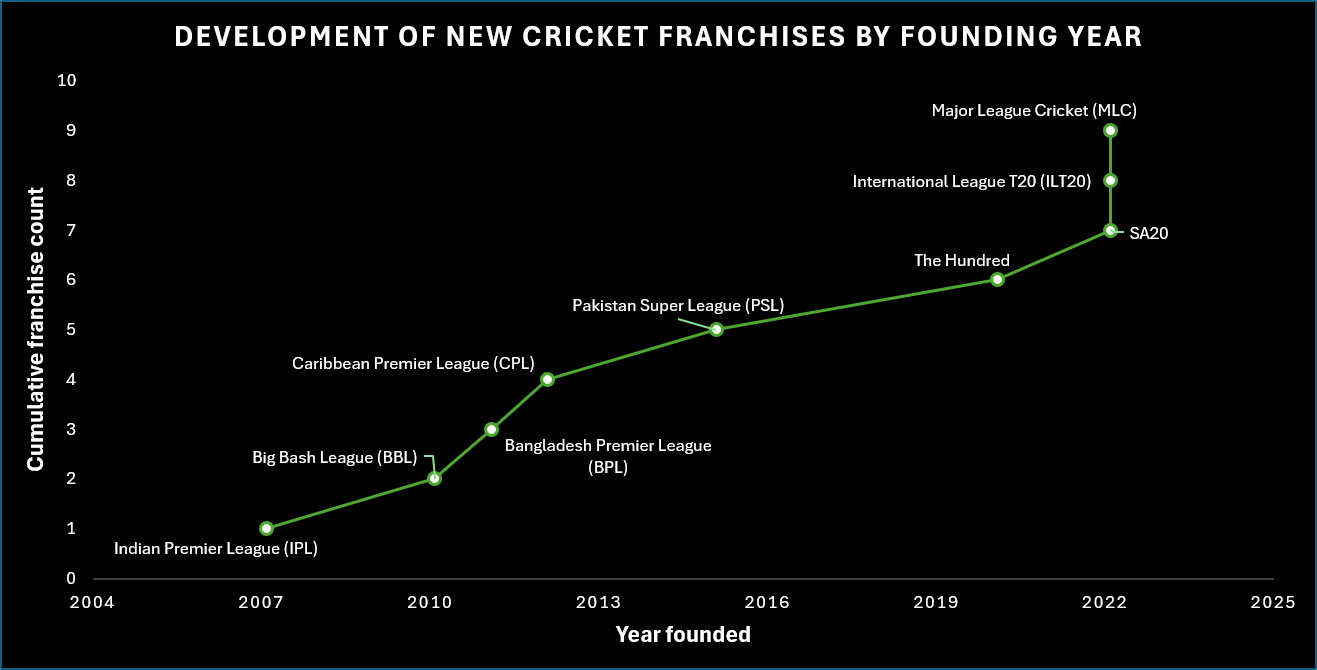
The IPL might be the biggest, but it's far from the only franchise competition now.
Australia has the Big Bash League. South Africa has SA20. The UAE has the International League T20. The USA has Major League Cricket. The Caribbean has the CPL. England has The Hundred.
What's really interesting is that many of these competitions are now connected.
IPL owners aren't just investing in India anymore. They're building global cricket portfolios.
The owners of Mumbai Indians now own teams in South Africa, the UAE and the USA. Kolkata Knight Riders and Delhi Capitals have followed a similar strategy.
It's becoming cricket's version of a multi-club ownership model.
So Why Are Investors Interested?
At first glance, buying a cricket team sounds risky.
But investors aren't just buying a sports team.
They're buying media rights, sponsorship opportunities, merchandise sales, ticket revenue and, perhaps most importantly, future growth.
Sport has become one of the world's biggest entertainment industries, and cricket still has huge room to expand internationally.
If franchise valuations continue growing like they have in the IPL, early investors could see significant returns.
Just look at what's happened with football clubs over the past twenty years.
Many have multiplied in value despite making relatively modest profits.
Sometimes it's the asset itself that's appreciating.
The Hundred Just Changed the Game
That brings us to England.
When The Hundred launched in 2021, plenty of traditional fans weren't convinced.
Did cricket really need another format?
Fast forward a few years and the conversation has completely changed.
The England and Wales Cricket Board has sold minority stakes in all eight Hundred teams to private investors, with several IPL owners among the successful buyers.
The deals valued the teams collectively at well over £900 million, bringing a huge injection of capital into English cricket.
That's money that can be invested into counties, grassroots cricket and facilities.
Whether it actually gets used that way remains to be seen.
But What About Test Cricket?
This is where things get interesting.
Every franchise tournament competes for the same thing.
Players.
The more money franchise leagues offer, the harder it becomes to convince players to prioritise international cricket.
We've already seen players retire from certain international formats to focus on franchise opportunities.
Test cricket doesn't generate the same financial rewards for many players, particularly outside the "Big Three" teams - India, Australia and England.
That's a genuine concern.
At the same time, it's worth remembering that franchise cricket is bringing new fans into the sport.
Some of those fans will eventually discover Test cricket.
Others won't.
Finding the balance between protecting cricket's traditions while embracing commercial growth is probably the biggest challenge facing the game.
Does The Hundred Replace The Blast?
Now here's the question plenty of people are asking.
Can English cricket really sustain both the T20 Blast and The Hundred?
The Blast has history. It has county rivalries. It has loyal supporters.
But The Hundred has television audiences, bigger commercial backing and now significant private investment.
Running two short-format competitions every summer creates fixture congestion and divides players.
A future where the two competitions merge doesn't seem impossible.
Whether that means counties becoming franchise teams, or The Hundred evolving into a more traditional T20 competition, nobody knows.
But maintaining two competing domestic white-ball tournaments forever feels increasingly difficult.
So... Is Franchise Cricket a Good Investment?
From a financial perspective, it's hard to argue against it.
Media rights continue to grow. Global audiences are increasing. Franchise values are rising.
Private equity firms and billionaire investors aren't buying cricket teams because they love cricket, they're buying them because they believe they'll become more valuable.
That doesn't mean there aren't risks.
The market could become saturated if too many franchise leagues emerge.
Player availability is already becoming an issue, and traditional domestic competitions risk being squeezed out.
Ultimately, the challenge for cricket isn't whether franchise investment is good.
It's whether the sport can embrace commercial success without losing the traditions that made it so popular in the first place.
Because while billion-pound valuations are exciting, nobody wants to see a future where Test cricket becomes an afterthought.
The next decade will probably decide whether franchise cricket strengthens the game, or changes it beyond recognition.
Share this episode
Comments
Sign in to read and join the conversation.
Sign in to comment